 Why Japan?
Real Ninjas Never Wore Black. So Who Did?
 Told by Sophie, your guide to Japan
Everyone pictures the same ninja: a man in black. Sophie traces where that picture came from — the kabuki stagehand whose black clothes meant “not here”, the seven disguises real agents actually used, Iga and Koga in 1581, the guards at Edo Castle, and how a costume built to say “don’t look” became the most recognisable outfit in Japan.
The full story
In this story
- The Man in Black on the Kabuki Stage
- Putting a Ninja in the Play
- Hokusai Draws the Costume
- Seven Ways to Be Someone Else
- The Disguise Did the Work
- The Colors of Night
- Iga and Koga
- 1581 and the Iga Crossing
- Guards at Edo Castle
- The Man in Black Keeps Growing
- A Costume That Does the Opposite
- No Portrait, No Costume
The Man in Black on the Kabuki Stage
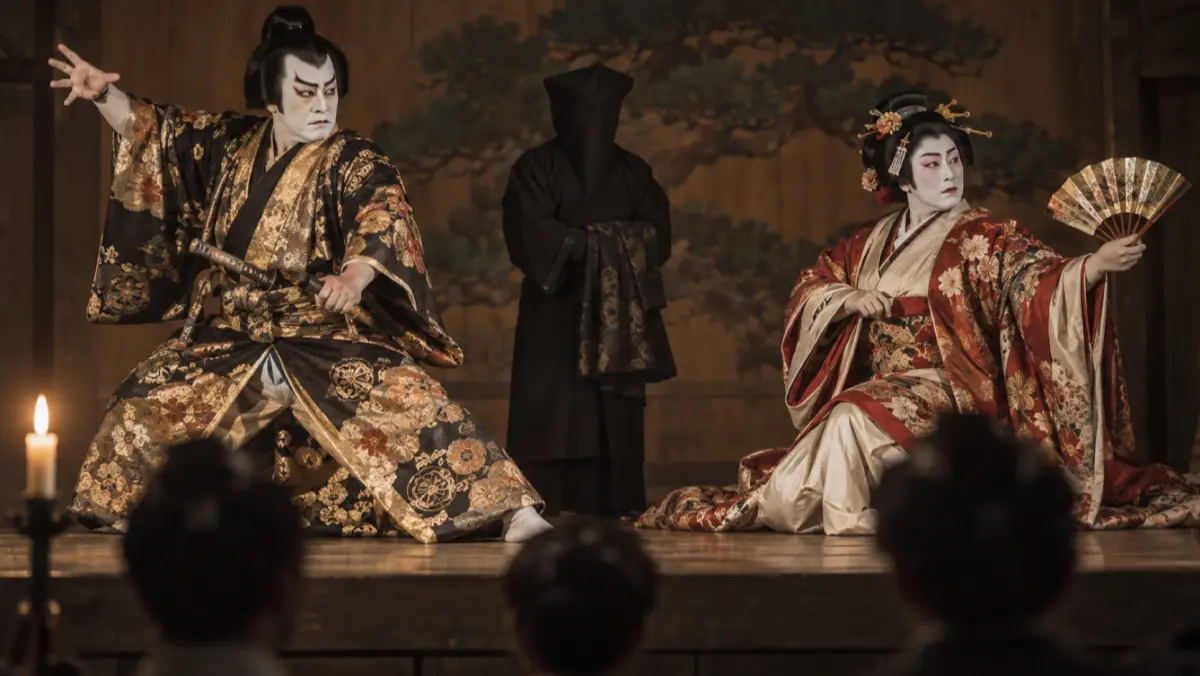
Start on a stage. Edo, sometime in the 1700s. A kabuki play is running. The actors are in silk, painted, lit by candles. And moving between them, in plain sight, is a man in black. Black robe, black hood, black gloves. He hands an actor a fan. He pulls away a cloak. He moves a lantern. Nobody in the audience looks at him. That is the deal. He is called a kuroko, and the rule of the theater says, a man in black is not there.
Putting a Ninja in the Play
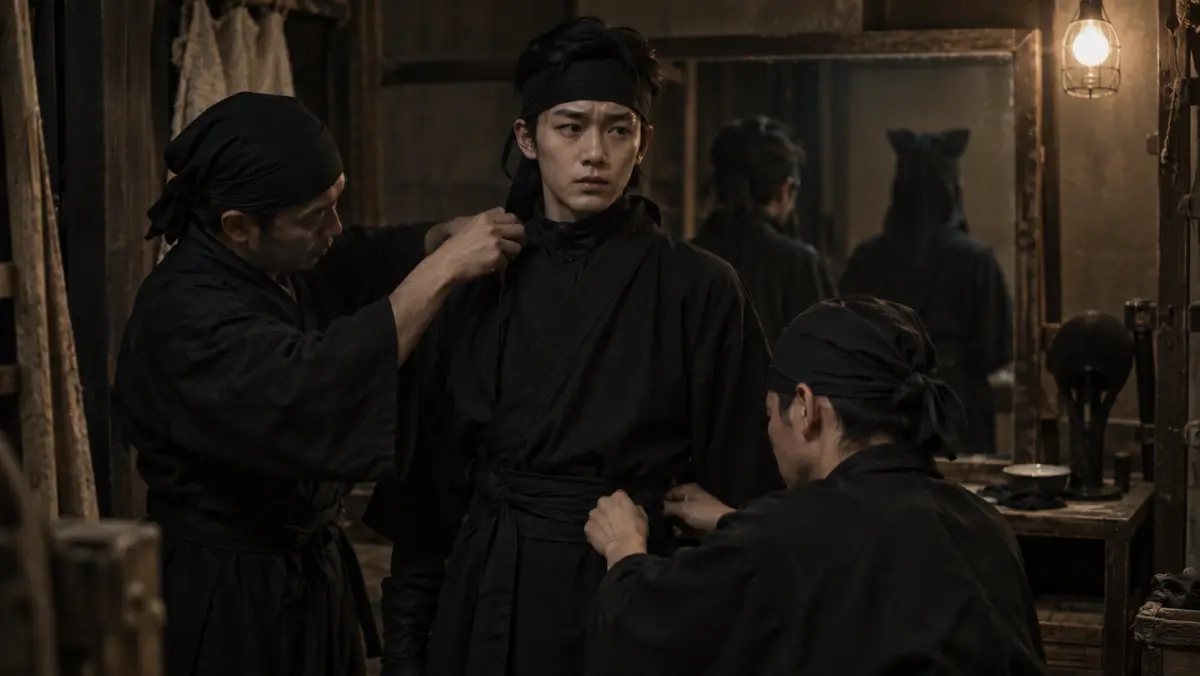
Now put a ninja in that play. This is how the explanation usually goes. The script needs a spy who appears out of nowhere and vanishes again. How do you stage that? You dress him like the stagehands. He walks on, and the audience does not see him, because they have trained themselves not to see men in black. Then he strikes, and the whole house jumps. The trick only works if the audience has already agreed that black means invisible. It is a piece of stagecraft, and a very good one.
Hokusai Draws the Costume
So that, most likely, is where the picture comes from. It is often said that some of the earliest drawings of a ninja in black date from the early 1800s, when artists like Hokusai sketched a hooded figure climbing a rope. By then the great civil wars were two hundred years in the past. Hokusai was not drawing a spy from a battlefield. He was drawing an image his own city had built, on stages and in picture books. And the stage already had a costume ready.
Seven Ways to Be Someone Else
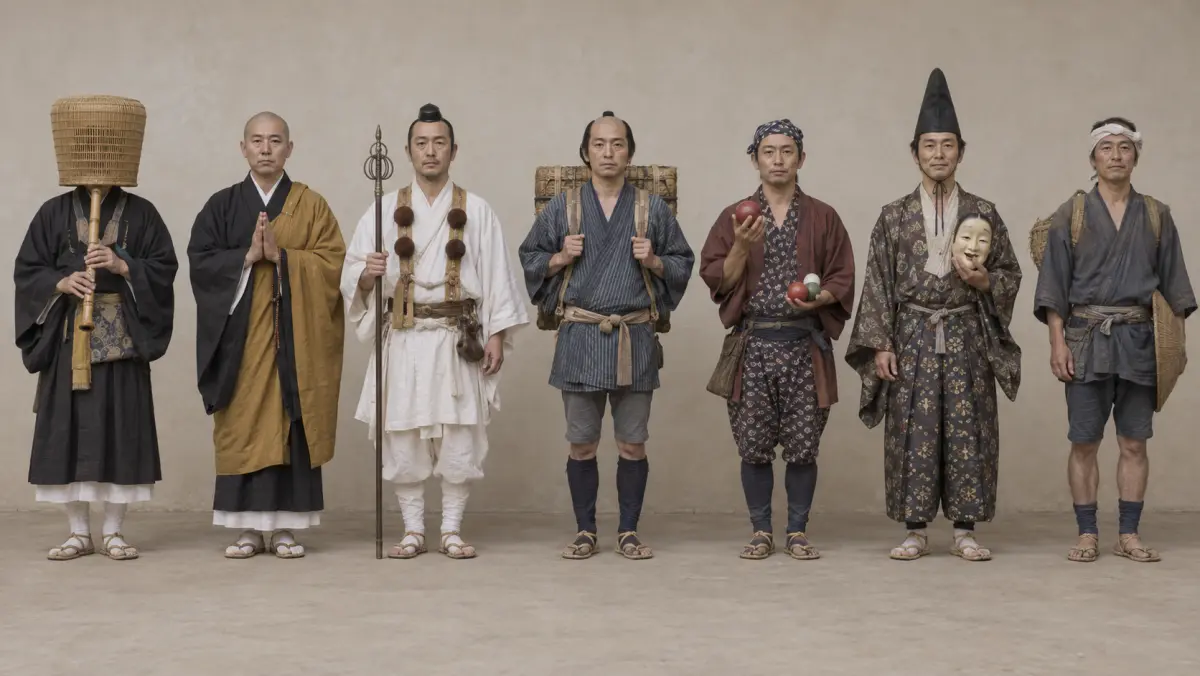
The word the old texts use is shinobi. It means to hide, or to endure. A shinobi's job was to go somewhere he was not supposed to be, learn something, and come back. For that, the last thing you want is to look like a spy. The manuals written in the 1600s list disguises instead. A traveling monk. A priest. A mountain ascetic. A merchant. A street performer. A wandering entertainer. And simply, an ordinary man. Seven ways to be someone else. And none of them is a special outfit.
The Disguise Did the Work
Think about why. A man in a monk's robe can stand at a gate and ask questions. A performer can enter a castle town and be welcomed. A merchant can carry a heavy pack without anyone asking what is in it. The disguise did the work before the shinobi did anything at all. If he was good, his whole mission looked, from the outside, like a slightly boring day.
The Colors of Night

And at night? One of those manuals does talk about color. It recommends plain, dull cloth. Brown. Persimmon. Black. Indigo. The colors of a farmer's work clothes, the colors of anyone's clothes after dark. Black is on the list. But it is on the list next to brown. What the manual never describes is a matching suit, head to toe, with a hood. The idea was never a color. The idea was to look like nothing in particular.
Iga and Koga
So who were they. Lords all over Japan used men like this, and called them different names. But the most famous came from two mountain regions, Iga and Koga, only a day or two's walk from Kyoto. Villages of small families with no single great lord over them, who sold what they had. And what they had was skill. Walking far. Listening. Counting soldiers. Starting fires. Getting over a wall. During the long civil wars of the 1500s, warlords paid for that. The word ninja was not a class or a rank. It was closer to a trade.
1581 and the Iga Crossing
In 1581, the warlord Oda Nobunaga sent an army into Iga and burned it. The villages scattered. And then, a year later, the story turns. After Nobunaga's death, a lord named Tokugawa Ieyasu was caught far from home and had to get back across the mountains to survive. The route is remembered as the Iga crossing. Later records say that local men from Iga and Koga helped guide him, though exactly who, and exactly which path, is still argued about. What is not argued about is what came after. When Ieyasu built his government in Edo, families from Iga came with him.
Guards at Edo Castle
And what did they do in Edo? Many of them guarded gates. For two and a half centuries of peace, descendants of the shinobi stood watch at doors of Edo Castle, patrolled at night, guarded the inner residences, and drew a small salary. One gate of the castle is still said to carry their leader's name. Hanzō's gate. Later, in the 1700s, a shogun kept a small group of trusted men as his private eyes and ears. Quiet work. No climbing. No black. For a good part of these families, secrecy had turned into ordinary government service, with a roster and a shift.
The Man in Black Keeps Growing
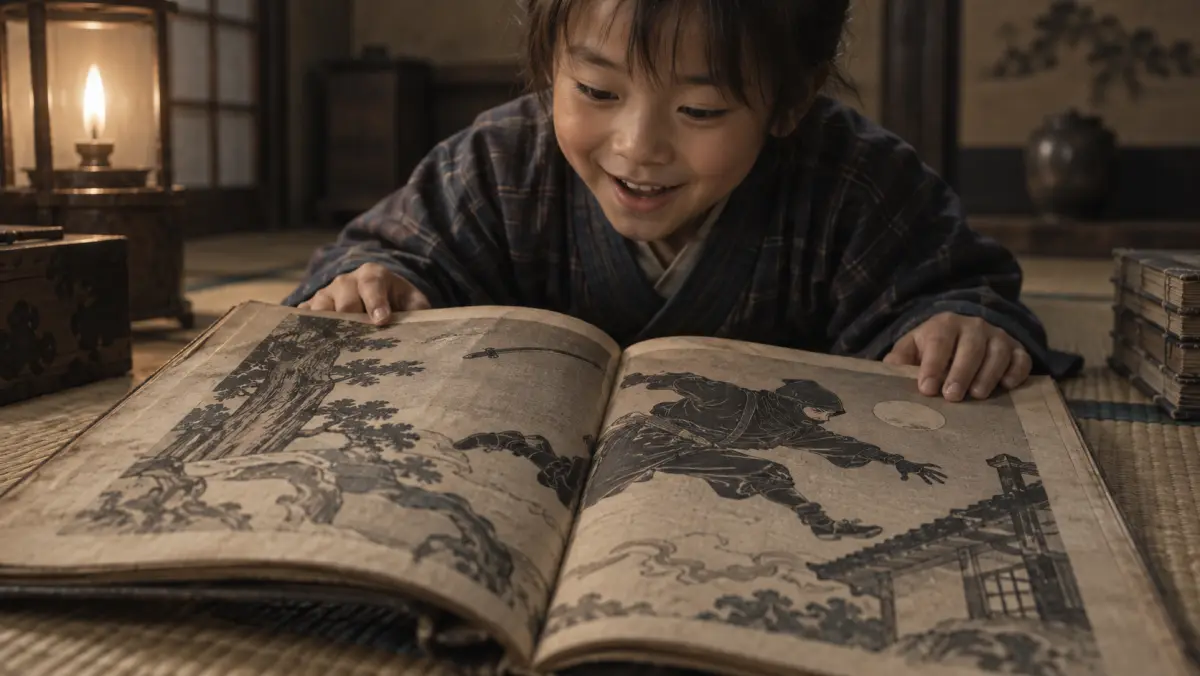
Meanwhile, the man in black kept growing. Illustrated storybooks in the late Edo period. A boy hero called Sarutobi Sasuke in cheap novels in the nineteen tens, who could leap and vanish. Then film. In 1962, a movie called Shinobi no Mono put a lean, silent man in a dark hood on Japanese screens, and it was a hit, and there were sequels. By the 1980s the figure had crossed the ocean. American films. Toys. Turtles. Video games. Each version borrowed the same costume, because the costume was the only thing everyone already agreed on.
A Costume That Does the Opposite
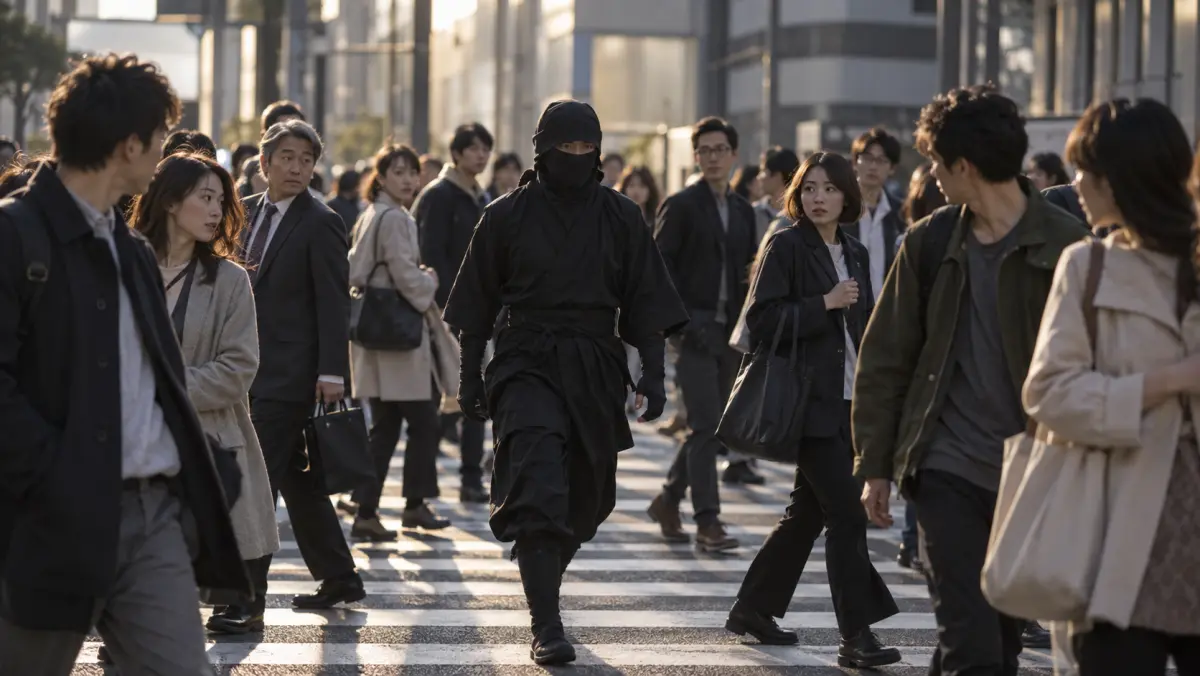
Here is the strange part. The black suit, as far as anyone can tell, was borrowed from a stage where black already meant, do not look here. It became the most recognizable outfit in the world. Something designed to say, do not look here, now says ninja from a hundred meters away, on a lunchbox. It succeeded at the exact opposite of its job.
No Portrait, No Costume
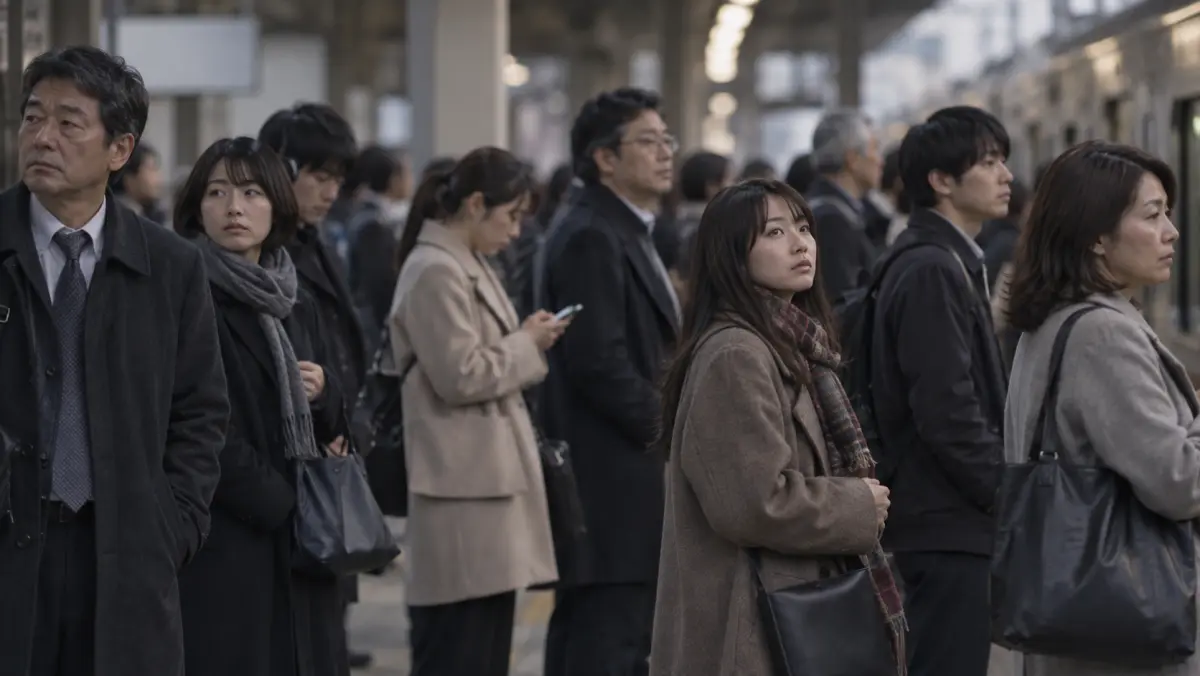
And the real ones? They did leave records. Manuals. Family papers. Duty rosters. Old maps of where they lived in Edo. Read them, and you learn a great deal about what these men did. Where they stood. What they were paid. Who they answered to. What the records almost never give you is a face. No portrait. No costume. Nothing to picture. Which is, if you think about it, exactly what they were paid for.
Where to see it
- Iga, Mie — One of the two famous homes of ninja, with Koga. In 1581 Oda Nobunaga’s army invaded Iga. Google Maps
Enjoyed the story? Sophie answers a new question about Japan every few days on YouTube.
Subscribe on YouTube

